Programmes and achievements
Foodedit
Codex Alimentariusedit
FAO and the World Health Organization created the Codex Alimentarius Commission in 1961 to develop food standards, guidelines and texts such as codes of practice under the Joint FAO/ WHO Food Standards Programme. The main aims of the programme are protecting consumer health, ensuring fair trade and promoting co-ordination of all food standards work undertaken by intergovernmental and non-governmental organization.
World Food Summitedit
In 1996, FAO organized the World Food Summit, attended by 112 Heads or Deputy Heads of State and Government. The Summit concluded with the signing of the Rome Declaration, which established the goal of halving the number of people who suffer from hunger by the year 2015. At the same time, 1,200 civil society organizations (CSOs) from 80 countries participated in an NGO forum. The forum was critical of the growing industrialization of agriculture and called upon governments – and FAO – to do more to protect the 'Right to Food' of the poor.
TeleFoodedit
In 1997, FAO launched TeleFood, a campaign of concerts, sporting events and other activities to harness the power of media, celebrities and concerned citizens to help fight hunger. Since its start, the campaign has generated close to US$28 million, €15 million in donations. Money raised through TeleFood pays for small, sustainable projects that help small-scale farmers produce more food for their families and communities.
The projects provide tangible resources, such as fishing equipment, seeds and agricultural implements. They vary enormously, from helping families raise pigs in Venezuela, through creating school gardens in Cape Verde and Mauritania or providing school lunches in Uganda and teaching children to grow food, to raising fish in a leper community in India.
FAO Goodwill Ambassadorsedit
The FAO Goodwill Ambassadors Programme was initiated in 1999. It was created to increase public awareness and to disseminate information about issues related to food security and hunger in the world.
Right to Food Guidelinesedit
In 2004 the Right to Food Guidelines were adopted, offering guidance to states on how to implement their obligations on the right to food.
Response to food crisisedit
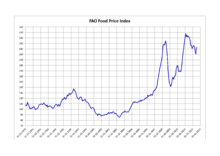
In December 2007, FAO launched its Initiative on Soaring Food Prices to help small producers raise their output and earn more. Under the initiative, FAO contributed to the work of the UN High-Level Task Force on the Global Food Crisis, which produced the Comprehensive Framework for Action. FAO has carried out projects in over 25 countries and inter-agency missions in nearly 60, scaled up its monitoring through the Global Information and Early Warning System on Food and Agriculture, provided policy advice to governments while supporting their efforts to increase food production, and advocated for more investment in agriculture. s also worked hand-in-hand with the European Union. One example of its work is a US$10.2 million, €7.5 billion scheme to distribute and multiply quality seeds in Haiti, which has significantly increased food production, thereby providing cheaper food and boosting
FAO–EU partnershipedit
In May 2009, FAO and the European Union signed an initial aid package worth €125 million to support small farmers in countries hit hard by rising food prices. The aid package falls under the EU's €1 billion Food Facility, set up with the UN Secretary-General's High-Level Task Force on the Global Food Crisis and FAO to focus on programmes that will have a quick but lasting impact on food security. FAO is receiving a total of around €200 million for work in 25 countries, of which €15.4 million goes to Zimbabwe.
Food security programmesedit
The Special Programme for Food Security is FAO's flagship initiative for reaching the goal of halving the number of hungry in the world by 2015 (currently estimated at close to 1 billion people), as part of its commitment to the Millennium Development Goals. Through projects in over 100 countries worldwide, the programme promotes effective, tangible solutions to the elimination of hunger, undernourishment and poverty. Currently 102 countries are engaged in the programme and of these approximately 30 have begun shifting from pilot to national programmes. To maximize the impact of its work, FAO strongly promotes national ownership and local empowerment in the countries in which it operates.
Online campaign against hungeredit
The 1billionhungry project became the EndingHunger campaign in April 2011. Spearheaded by FAO in partnership with other UN agencies and private nonprofit groups, the EndingHunger movement pushes the boundaries of conventional public advocacy. It builds on the success in 2010 of The 1billonhungry project and the subsequent chain of public events that led to the collection of over three million signatures on a global petition to end hunger (www.EndingHunger.org). The petition was originally presented to representatives of world governments at a ceremony in Rome on 30 November 2010.
The web and partnerships are two pivotal and dynamic aspects of EndingHunger. The campaign relies on the assistance of organizations and institutions that can facilitate the project's diffusion, by placing banners on their own websites or organizing events aimed to raise awareness of the project. In its 2011 season, the campaign expanded its multimedia content, pursued mutual visibility arrangements with partner organizations, and sharpened its focus on 14- to 25-year-olds, who were encouraged to understand their potential as a social movement to push for the end of hunger.
Moreover, the EndingHunger project is a viral communication campaign, renewing and expanding its efforts to build the movement through Facebook, Twitter and other social networks. Those who sign the petition can spread the link of the EndingHunger website to their friends, via social media or mail, in order to gain awareness and signatures for the petition. The next interim objective is to grow the EndingHunger movement's Facebook community to 1 million members. As with the petition, the more people who get involved, the more powerful the message to governments: "We are no longer willing to accept the fact that hundreds of millions live in chronic hunger." Groups and individuals can also decide on their own to organize an event about the project, simply by gathering friends, whistles, T-shirts and banners (whistles and T-shirts can be ordered, and petition sign sheets downloaded, on the endinghunger.org website) and thereby alert people about chronic hunger by using the yellow whistle.
The original 1billionhungry campaign borrowed as its slogan the line "I'm as mad as hell, and I'm not going to take this anymore!", used by Peter Finch in the 1976 film, Network. Meanwhile, the yellow whistle has been the campaign symbol from the start, from 1billionhungry to Ending Hunger. (The creative concept was provided by the McCann Erickson Italy Communication Agency.) It symbolizes the fact that we are "blowing the whistle" on the silent disaster of hunger. It is both a symbol and – at many live events taking place around the world – a physical means of expressing frustration and making some noise about the hunger situation.
Both The 1billionhungry and the EndingHunger campaigns have continued to attract UN Goodwill Ambassadors from the worlds of music and cinema, literature, sport, activism and government. Some of the well known individuals who have become involved include former Brazilian President Luiz Inácio Lula da Silva, former presidents of Chile Ricardo Lagos and Michelle Bachelet, actress Susan Sarandon, actors Jeremy Irons and Raul Bova, singers Céline Dion and Anggun, authors Isabelle Allende and Andrea Camilleri, musician Chucho Valdés and Olympic track-and-field legend Carl Lewis.
75 years of the FAOedit
Over the past 75 years, the FAO's outlook and body of work have acquired new environmental and sustainability dimensions, with a strategic re-invention taking place in 2020. As the COVID-19 pandemic exacerbates vulnerabilities linked to conflict and climate change and with only ten years left to achieve the Sustainable Development Goals, there has been an emphasis on leveraging research partnerships, digitalization and innovation to help end hunger and malnutrition.
Agricultureedit
International Plant Protection Conventionedit
FAO created the International Plant Protection Convention or IPPC in 1952. This international treaty organization works to prevent the international spread of pests and plant diseases in both cultivated and wild plants. Among its functions are the maintenance of lists of plant pests, tracking of pest outbreaks, and coordination of technical assistance between member nations. As of July 2018, 183 contracting parties have ratified the treaty.
Plant Treaty (ITPGRFA)edit
FAO is depositary of the International Treaty on Plant Genetic Resources for Food and Agriculture, also called Plant Treaty, Seed Treaty or ITPGRFA, entered into force on 29 June 2004.
Alliance Against Hunger and Malnutritionedit
The Alliance Against Hunger and Malnutrition (AAHM) aims to address how countries and organizations can be more effective in advocating and carrying out actions to address hunger and malnutrition. As a global partnership, AAHM creates global connections between local, regional, national and international institutions that share the goals of fighting hunger and malnutrition. The organization works to address food security by enhancing resources and knowledge sharing and strengthening hunger activities within countries and across state lines at the regional and international levels.
Following the World Food Summit, the Alliance was initially created in 2002 as the 'International Alliance Against Hunger (IAAH)' to strengthen and coordinate national efforts in the fight against hunger and malnutrition. The mission of the Alliance originates from the first and eight UN Millennium Development Goals; reducing the number of people that suffer from hunger in half by 2015 (preceded by the "Rome Declaration" in 1996) and developing a global partnership for development. The Alliance was founded by the Rome-based food agencies – the Food and Agriculture Organization of the United Nations (FAO), UN World Food Programme (WFP), International Fund for Agricultural Development (IFAD), – and Bioversity International.
AAHM connects top-down and bottom-up anti-hunger development initiatives, linking governments, UN organizations, and NGOs together in order to increase effectiveness through unity.
Integrated pest managementedit
During the 1990s, FAO took a leading role in the promotion of integrated pest management for rice production in Asia. Hundreds of thousands of farmers were trained using an approach known as the Farmer Field School (FFS). Like many of the programmes managed by FAO, the funds for Farmer Field Schools came from bilateral Trust Funds, with Australia, Netherlands, Norway and Switzerland acting as the leading donors. FAO's efforts in this area have drawn praise from NGOs that have otherwise criticized much of the work of the organization.
Transboundary pests and diseasesedit
FAO established an Emergency Prevention System for Transboundary Animal and Plant Pests and Diseases in 1994, focusing on the control of diseases like rinderpest, foot-and-mouth disease and avian flu by helping governments coordinate their responses. One key element is the Global Rinderpest Eradication Programme, which has advanced to a stage where large tracts of Asia and Africa have now been free of the cattle disease rinderpest for an extended period of time. Meanwhile, Locust Watch monitors the worldwide locust situation and keeps affected countries and donors informed of expected developments.
Global Partnership Initiative for Plant Breeding Capacity Buildingedit
The Global Partnership Initiative for Plant Breeding Capacity Building (GIPB) is a global partnership dedicated to increasing plant breeding capacity building. The mission of GIPB is to enhance the capacity of developing countries to improve crops for food security and sustainable development through better plant breeding and delivery systems. The ultimate goal is to ensure that a critical mass of plant breeders, leaders, managers and technicians, donors and partners are linked together through an effective global network.
Increasing capacity building for plant breeding in developing countries is critical for the achievement of meaningful results in poverty and hunger reduction and to reverse the current worrisome trends. Plant breeding is a well recognized science capable of widening the genetic and adaptability base of cropping systems, by combining conventional selection techniques and modern technologies. It is essential to face and prevent the recurrence of crises such as that of the soaring food prices and to respond to the increasing demands for crop based sources of energy.
Investment in agricultureedit
FAO's technical cooperation department hosts an Investment Centre that promotes greater investment in agriculture and rural development by helping developing countries identify and formulate sustainable agricultural policies, programmes and projects. It mobilizes funding from multilateral institutions such as the World Bank, regional development banks and international funds as well as FAO resources.
Globally Important Agricultural Heritage Systems (GIAHS)edit
The Globally Important Agricultural Heritage Systems (GIAHS) Partnership Initiative was conceptualized and presented by Parviz Koohafkan the Task Manager of Chapter 10 of Agenda 21 in Food and Agricultural Organization of United Nations, FAO in 2002 during World Summit on Sustainable Development in Johannesburg, South Africa.citation needed This UN Partnership Initiative aims to identify, support and safeguard Globally Important Agricultural Heritage Systems and their livelihoods, agricultural and associated biodiversity, landscapes, knowledge systems and cultures around the world. The GIAHS Partnership recognizes the crucial importance of the well-being of family farming communities in an integrated approach while directing activities towards sustainable agriculture and rural development.
Commission on Genetic Resources for Food and Agriculture (CGRFA)edit
The Commission on Genetic Resources for Food and Agriculture was established in 1983 and provides a unique intergovernmental forum that specifically addresses biological diversity for food and agriculture. Its main objective is to ensure the sustainable use and conservation of biodiversity for food and agriculture and the fair and equitable sharing of benefits derived from its use, for present and future generations.http://www.fao.org/cgrfa/en/
Animal Genetic Resourcesedit
FAO has a unit focused on Animal Genetic Resources, which are defined as "those animal species that are used, or may be used, for the production of food and agriculture, and the populations within each of them. These populations within each species can be classified as wild and feral populations, landraces and primary populations, standardised breeds, selected lines, varieties, strains and any conserved genetic material; all of which are currently categorized as Breeds." FAO assists countries in implementation of the Global Plan of Action for Animal Genetic Resources. FAO supports a variety of ex situ and in situ conservation strategies including cryoconservation of animal genetic resources.
Forestryedit
One of FAO's strategic goals is the sustainable management of the world's forests. The Forestry Department works to balance social and environmental considerations with the economic needs of rural populations living in forest areas. FAO serves as a neutral forum for policy dialogue, as a reliable source of information on forests and trees and as a provider of expert technical assistance and advice to help countries develop and implement effective national forest programmes.
FAO is both a global clearinghouse for information on forests and forest resources and a facilitator that helps build countries' local capacity to provide their own national forest data. In collaboration with member countries, FAO carries out periodic global assessments of forest resources, which are made available through reports, publications and the FAO's Web site. The Global Forest Resources Assessment provides comprehensive reporting on forests worldwide every five years. FRA 2015 is the most recent global assessment. The results, data and analyses are available online in different formats, including the FAO synthesis report Global Forest Resources Assessment 2015: How are forests changing?, the Global Forest Resources Assessment 2015 Desk Reference containing summary tables, 234 country reports and the FRA 2015 Infographics. Moreover, in 2015, the journal Forest Ecology and Management published a special issue, Changes in Global Forest Resources from 1990 to 2015 reporting forest change over the period 1990–2015.
Every two years, FAO publishes the State of the World's Forests, a major report covering current and emerging issues facing the forestry sector.
Since 1947, FAO has published the FAO Yearbook of Forest Products, a compilation of statistical data on basic forest products from over 100 countries and territories of the world. It contains data on the volume of production; and the volume, value and direction of trade in forest products.
Unasylva, FAO's peer-reviewed journal on forestry, has been published in English, French and Spanish on a regular basis since 1947, the longest-running multilingual forestry journal in the world.
The FAO is an official sponsor of International Day of Forests, on 21 March each year, as proclaimed by the United Nations General Assembly on 28 November 2012.
Every 6 years since 1926, FAO and a host member state hold the World Forestry Congress. It is a forum for the sharing of knowledge and experience regarding the conservation, management and use of the world's forests, and covers such issues as international dialogue, socio-economic and institutional aspects, and forest policies.
The Forestry Department is also organized geographically in several groups covering the whole world's forest ecosystems. One of them is the Silva mediterranea workgroup, covering the pan-mediterranean region.
Tree Cities of the Worldedit
At the World Forum on Urban Forests in October 2018, the FAO and the Arbor Day Foundation jointly launched the Tree Cities of the World programme. The aim of this programme is to celebrate and recognize cities and towns of all sizes throughout the world which have shown a commitment to maintaining their urban forests. From the end of 2019, any municipality which has responsibility for its trees were able to apply to join Tree Cities of the World. On 4 February 2020, 59 cities were announced as having achieved the designation of Tree City of the World. There were 27 in the United States, with the rest scattered across the world.
Fisheriesedit
The FAO Fisheries and Aquaculture Department is defined through its vision and mission statements:
- Vision: A world in which responsible and sustainable use of fisheries and aquaculture resources makes an appreciable contribution to human well-being, food security and poverty alleviation.
- Mission: To strengthen global governance and the managerial and technical capacities of members and to lead consensus-building towards improved conservation and utilization of aquatic resources.
The work of the Fisheries and Aquaculture Department centers on the "Sustainable management and use of fisheries and aquaculture resource," embracing normative as well as operational activities, whether implemented from headquarters or from the field.citation needed
Statisticsedit
ESSG is an acronym for the Global Statistics Service, the major "section" of the United Nations' Food and Agriculture Organization - Statistics Division. It is responsible for updating and disseminating the FAOSTAT report. This offers free and easy access to data for 245 countries and 35 regional areas from 1961 through the most recent year available. Enhanced features include browsing and analysis of data, an advanced interactive data download, and enhanced data exchange through web services.
The Land and Water Division maintains a database of global water statistics, Aquastat.

Comments
Post a Comment